

Eight Months per Car and Four Years per Track: This Is How Gran Turismo Is Built
By Redacción UWLG · Source: Gamereactor España

Kazunori Yamauchi, creator of the Gran Turismo series, has put numbers on something many of us suspected but few knew precisely: how much work goes into every car and every track in Polyphony Digital's simulator. In an interview with the British motoring magazine Evo, reported by Gamereactor España, Yamauchi explains that modeling a single car takes around eight months, while a track can require up to four years of development. The example he gives is the most feared of them all: the Nürburgring Nordschleife.
The figure matters because it lines up with the franchise's reality over the last decade. Since 2017, only one full installment has been released, Gran Turismo 7, which arrived in 2022 and which Sony has kept feeding with new content ever since. For those competing in the GT ecosystem or creating content around the game, understanding these timelines helps set expectations for updates and, above all, for when (or whether) we will see an eighth installment in the near future.
What you need to know
- Every Gran Turismo car requires around eight months of work, counting exterior and interior modeling plus the physics that define how it behaves.
- A track can take up to four years: recreating the Nürburgring Nordschleife took exactly that long.
- Since 2017, only one full game in the series has been released, Gran Turismo 7 (2022), which continues to receive content on a steady basis.
- Gran Turismo 8 has no release date, and the source suggests its arrival would be tied to the launch of a new PlayStation.
- The underlying information comes from an interview Yamauchi gave to the British magazine Evo, reported by Gamereactor España.
Eight months per car, four years per track
As Yamauchi explains, every vehicle needs an extremely detailed computer graphics model, covering both the bodywork and the interior, and on top of that the physics that determine how the car behaves on track have to be built. That whole package, looks and dynamics, eats up around eight months per unit. It is not a simple scan: it is a process that combines art, engineering and calibration.
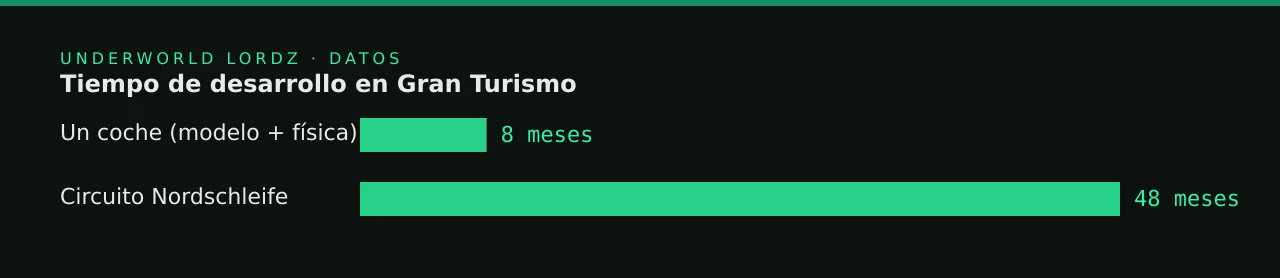
Tracks are another league entirely. Recreating the Nordschleife, with its more than twenty kilometers of corners, elevation changes and surroundings, took the studio four years. If we put both figures on the same timescale, the difference is staggering:
| Element | Development time | In months |
|---|---|---|
| One car (model + physics) | Eight months | 8 |
| Nordschleife track (Nürburgring) | Four years | 48 |
Put another way: the most demanding track in the series is equivalent, in time, to building six complete cars. And that is without counting the rest of the game's production.
A release cadence we already knew
These numbers explain Polyphony's schedule better than any press release could. The fact that only one full Gran Turismo has been released since 2017 stops looking like an anomaly when every piece of the puzzle costs months or years. Sony has chosen to sustain GT7 with new content rather than rush a sequel, and the source notes that the eighth installment does not look likely to arrive before a new PlayStation is on the table.
For the competitive scene, the takeaway is clear: GT7 is going to remain the go-to platform for quite a while longer, and new additions will come in the form of cars and tracks trickled out over time, not a new game every two years.
Our take
At Underworld Lordz, we value obsession with detail. A studio taking four years to nail the Nordschleife is what sets Gran Turismo apart from the competition when it comes to driving feel, and any driver who has fought through an online race on that track knows that work shows in every corner. That level of fidelity is, in part, what keeps the series a top-tier esports arena.
But we also have to be critical. Such a long cycle comes at a cost for the competitive community: fewer new tracks means repetitive metas, less variety in tournament calendars and a content curve that sometimes feels slow for those who play every day. For content creators the problem is similar: novelty is fuel, and one car every few months is not always enough to keep the spark alive on a channel. Sustaining a game for years is a sensible decision from a technical standpoint, but it demands that Polyphony be fully aware that the community needs reasons to come back.
Our position is simple: we would rather have a franchise that bets on quality and keeps alive the game we have already poured hundreds of hours into than a rushed sequel that resets the competitive ecosystem. That said, we hope the long road to GT8 comes with a clearer roadmap for GT7, because silence wears people down too.
What do you think?
Knowing what it takes to build every track, would you rather Polyphony keep feeding Gran Turismo 7 for years, or do you think the series needs a new installment now even if it ships with less content? Let us know in the team chat or on our Discord.
Your turn
What do you think?
Share your take in the team chat or on Discord. We feature the best opinions in the next article.
How did it land?
Community takes
…