
Gears of War: E-Day sells modestly, but Game Pass tells a different story
By Redacción UWLG · Source: GameSpot
Imagen: GameSpot
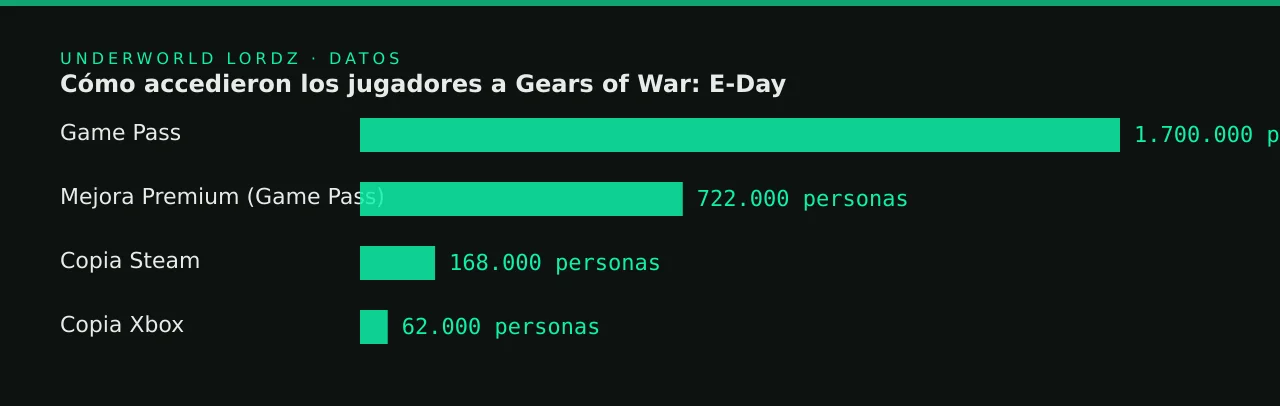
Gears of War: E-Day arrived this week as Microsoft's big exclusive, and we already have the first snapshot of its commercial launch. As reported by GameSpot, analyst Rhys Elliott of the consultancy Alinea Analytics estimates that the game has sold around 230,000 copies so far: 168,000 on Steam and 62,000 across the Xbox ecosystem, counting both console and PC. Taken at face value, those are modest figures for a series that was the flagship of the brand for years.
But the data matters precisely because direct sales no longer tell the whole story. E-Day has been on Game Pass since day one, and the same report indicates that 1.7 million people have picked it up through the subscription. In other words, the return of Marcus Fenix has become the perfect case study for understanding how Microsoft measures the success of its launches today, and how we, as players and creators, should measure it when deciding where to put our time and content.
What you need to know
- Traditional sales: roughly 230,000 copies in total, with Steam taking the lion's share (168,000) versus 62,000 on Xbox, according to Alinea Analytics.
- Game Pass dominates access: 1.7 million players got into the game through the subscription, and Elliott openly says the service “cannibalized” most of the sales.
- The Premium upgrade pays off: 722,000 of those subscribers paid an extra $30 for early access and additional content.
- The money is on Xbox: despite selling fewer copies than Steam, Microsoft's ecosystem accounts for nearly three quarters of the revenue, which the report puts at around $26 million for that share.
- First week: this is early data, from the first few days after launch, and the picture may change.
Cannibalization or strategy: the Game Pass paradox
The word Elliott uses is a strong one: cannibalize. And it makes sense if we only look at copies sold. When a game is available at no extra cost to millions of subscribers, a full-price purchase loses its appeal on Microsoft's platform. That explains why Steam, where no such alternative exists, clearly outpaces Xbox in units.
The flip side is the Premium upgrade. More than 700,000 people who already had the game “for free” chose to pay $30 to get in early and grab the extras. That figure turns what looked like a loss into a very solid revenue stream and, along the way, tells us something about the Gears community: there is a base willing to pay for a head start and for content. That is why, despite selling fewer copies, Xbox keeps most of the money.
| Access route | People | Note |
|---|---|---|
| Copy on Steam | 168,000 | Direct sale |
| Copy on Xbox (console and PC) | 62,000 | Direct sale |
| Game Pass | 1,700,000 | Subscription |
| Premium upgrade ($30) | 722,000 | Among Game Pass users |
What changes for the competitive scene
For those of us who experience the game from the competitive side, the number that matters is not copies sold but people playing. And there the reading is positive: nearly two million people with access in the first week is a player base that fills lobbies, shortens matchmaking times and brings community tournaments to life. Gears has always had a loyal competitive community, and a low barrier to entry is the best possible news for that community to grow rather than shrink.
The risk lies in retention. A player who comes in through a subscription is less committed than one who paid full price, and may vanish as soon as the next big release hits the catalog. The coming months will tell whether E-Day holds on to that mass of players or whether it was just a spike of curiosity.
Our take
At Underworld Lordz we believe that running the headline “Gears sells poorly” only scratches the surface. Microsoft has decided that success is measured in active subscribers and total revenue, not in units, and by those rules E-Day appears to be working. The fact that nearly three quarters of the money comes from the platform that sells the fewest copies is proof that the hybrid model, subscription plus paid upgrade, is designed for exactly this.
That said, we don't like everything about it. Charging $30 to play early a title that is already in the subscription normalizes a practice that splits the community into two tiers. For the competitive scene that is a real problem: whoever pays shows up with days of practice in hand, and in a niche shooter that difference is felt in the first tournaments and on the leaderboard. If Microsoft wants Gears to become a competitive benchmark again, it should make sure early access does not turn into a disguised pay-to-win advantage.
For content creators, on the other hand, the timing could not be better. There is a huge audience with the game installed and few hours logged, hungry for guides, map breakdowns and high-level matches. Anyone who establishes themselves in Gears now has a window that will not come around again once the Game Pass catalog moves on to the next thing.
What do you think?
The figures put the age-old debate back on the table: is a model that multiplies the player count worth it even if it sinks direct sales? And is it fair for $30 to buy days of advantage in a competitive game? Tell us in the team chat or on our Discord: did you get into E-Day through Game Pass, pay for the Premium upgrade or buy it on Steam, and why?
Your turn
What do you think?
Share your take in the team chat or on Discord. We feature the best opinions in the next article.
How did it land?
Community takes
…
Keep reading

Gaming
GTA 6 at $80: Warhorse wants that to be the new price of triple-A games

Gaming
Game Pass kicks off October 2026 with its first wave of games
Gaming
Ben Affleck admits he argues with 12-year-olds in Fortnite
Gaming
Resident Evil Requiem Started Life as an Online Game, and Capcom Shelved That to Go Back to Horror