Wardogs shuts down Steam Family Sharing: paying $40 as an "anticheat"
By Redacción UWLG · Source: PCGamesN
Imagen: PCGamesN
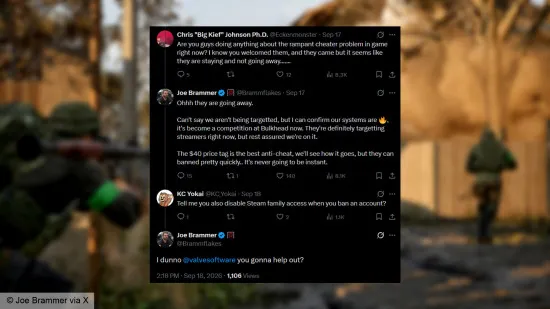
Bulkhead, the studio behind Wardogs, has disabled Steam's Family Sharing feature in its multiplayer shooter without any prior notice. According to PCGamesN, the decision comes amid an ongoing community debate about how to curb cheaters in the game, and it arrives alongside a statement from the CEO that has stirred plenty of discussion: the $40 price tag would be, in his words, the best possible anticheat.
The news matters for two reasons. The first is very practical: anyone who was playing Wardogs through a family member's or friend's shared library is suddenly locked out. The second is more fundamental, because it puts on the table an anti-cheat philosophy that bets on an economic barrier rather than technology, an approach that draws as much support as it does criticism among competitive players.
What you need to know
- Family Sharing disabled: Bulkhead has switched off the option to share Wardogs through Steam Family Sharing, and did so abruptly, without any prior announcement to prepare the community.
- The CEO's argument: the head of the studio maintains that the game's $40 price is "the best anticheat", meaning that having to pay again after every ban is a stronger deterrent than any software.
- Cheating context: according to PCGamesN, the move is part of discussions about countermeasures against cheating in the multiplayer FPS.
- Who it affects: anyone who was playing with a borrowed copy and, by extension, groups of friends who used the feature to try the game before buying it.
Why Family Sharing is a problem for shooters
Steam Family Sharing lets multiple accounts access the same user's library. It's a feature designed for households, but in competitive games it has a well-known side effect: a cheater can play on a borrowed copy, get banned, and come back with another account without having spent a thing. That's why it's not unusual for online FPS studios to restrict it. What's new in the Wardogs case isn't so much the measure itself as the way it was handled and the messaging around it.
By disabling the feature without warning, Bulkhead has left part of its player base feeling that the rules can change overnight. And by explicitly tying the decision to the idea that paying $40 is the best defense against cheaters, the studio is saying something deeper: that the cost of entry is part of its security strategy.
Price as a barrier: an idea with merit and with limits
The CEO's logic isn't new. The more each banned account costs, the less profitable it becomes to cheat systematically, and free-to-play games tend to suffer waves of cheaters precisely because creating a new account costs nothing. In that sense, a high entry price does filter out part of the problem.
But let's be clear: a price tag doesn't detect an aimbot or a wallhack. It only makes reoffending more expensive. Anyone willing to pay still has free rein until a real system catches them. Presenting the price as "the best anticheat" can be read as a statement of intent, or as a way of avoiding commitment to more expensive technical investments. The source doesn't detail what other countermeasures Wardogs has in place, so we won't speculate about that, but it's exactly the question the community should be asking next.
Our take
Here at the Underworld Lordz newsroom, we understand the decision to shut down Family Sharing: in a competitive shooter it's an open door that almost no serious studio leaves unlocked, and those of us who play ranked matches know what every round ruined by a cheater costs. If Bulkhead had simply announced the measure in advance and explained the reasoning, hardly anyone would have complained.
What doesn't convince us is the message. Saying the price is the best anticheat sounds good in a headline, but for a competitive player or a content creator whose audience is on the line every stream, it's an insufficient answer. We want to know what detection is behind it, how quickly bans are applied, and how transparent the studio will be with the data. An economic barrier is a complement, not a strategy. And doing it abruptly, without warning, punishes honest players first, the ones who were trying the game on a friend's account before deciding whether to buy it.
If Wardogs wants to establish itself as a competitive scene, it will have to prove there's more than a price tag protecting its servers. For now, the measure is reasonable; the messaging, not so much.
What do you think?
Some argue that a paid game will always be cleaner than a free-to-play one, while others believe that's just an excuse not to invest in a real anticheat. Tell us in the team chat or on our Discord: do you think paying $40 really stops cheaters, or is Bulkhead dodging the problem?
Your turn
What do you think?
Share your take in the team chat or on Discord. We feature the best opinions in the next article.
How did it land?
Community takes
…