

Windows 11 leaves you mute: the KB5124008 update breaks USB audio and there's no fix
By Redacción UWLG · Source: Vandal
Imagen: Vandal
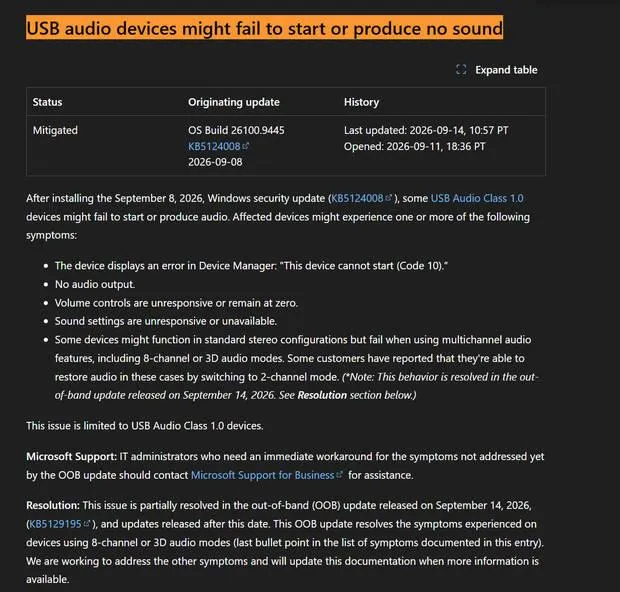
If you updated Windows 11 in the last few days and your headset suddenly went silent, take a breath: it's not broken. As reported by Vandal, Microsoft has confirmed that security update KB5124008 is causing problems with certain USB-connected audio devices. And the worst part of the story is that, for the time being, there is no official fix for this bug.
This matters because we're not talking about an obscure peripheral or an exotic setup. The failure hits devices that use the USB Audio Class 1.0 standard, a long-established specification that, according to the source, is still present in the vast majority of headsets, speakers and other audio peripherals. For any competitive player or content creator, losing audio in the middle of a ranked match, a scrim or a stream is the kind of problem that can't wait.
What you need to know
- Microsoft has officially acknowledged a bug in Windows 11 update KB5124008, the system's latest security patch.
- The problem affects USB Audio Class 1.0 devices, an old but still hugely widespread standard in headsets, speakers and audio peripherals.
- Symptoms vary depending on the machine and the peripheral; some users see the message "This device cannot start", while others experience nothing at all.
- For now there is no patch or official fix published by Microsoft.
- The underlying information comes from Vandal, which reports the confirmation from the manufacturer itself.
What's happening and who it affects
The update in question arrived as a security patch, meaning the kind Windows installs almost automatically and without most people paying any attention. The result, according to Vandal's report, is that on certain machines USB audio devices stop working properly and the system may return an error saying the device cannot start.
What makes this case tricky is the wide range of symptoms. As the source rightly points out, a PC has an enormous number of variables: motherboard, drivers, USB chipset, peripheral firmware, system version. With so many possible combinations, some players have their sound completely wrecked by the patch while others with the exact same headset notice absolutely nothing. That variability is what usually delays diagnosis and, by extension, the arrival of a definitive fix.
Why the 1.0 standard is still so widespread
Although it may sound like technology from the past, USB Audio Class 1.0 is the foundation that a huge number of mid-range and entry-level devices run on, precisely because it's compatible with almost everything and doesn't require specific drivers. The fact that an operating system bug affects that very standard means the potential impact is enormous, even if not every user experiences it the same way.
Background: this isn't the first time
The source's own headline says it: Windows 11 is once again causing problems for gamers. Anyone who has been on PC for a while knows that Microsoft's cumulative updates have a patchy track record when it comes to third-party hardware. The pattern repeats itself: a patch arrives, part of the user base reports failures, Microsoft acknowledges it on its known issues dashboard, and the fix takes as long as it takes. In the meantime, users are stuck choosing between uninstalling a security update or living with the bug.
Our take
Here at the Underworld Lordz newsroom we're not going to sugarcoat it: a security patch leaving a significant share of gamers without audio is a serious quality control failure. We understand that the variety of PC hardware is endless, but USB Audio Class 1.0 is not an edge case; it's the standard half the world uses. If anything should be in the test suite before rolling out a mass update, it's exactly that.
For a competitive player, audio isn't an accessory: it's footsteps, reloads, abilities and team communication. For a content creator, it's the microphone, monitoring and the stream mix. Having all of that depend on whether Windows decides to update itself on some random night strikes us as an unacceptable risk, and the fact that there's no official fix makes the problem worse. Microsoft's confirmation is fine as a first step, but acknowledging a bug is not the same as fixing it.
Our practical recommendation, until the patch arrives: if you compete or stream regularly, check which updates were installed recently, consider pausing automatic updates for a few days, and keep an audio alternative on hand (an analog output or a device using a different standard) in case the system fails on you right before an important match. It's not the ideal solution, but it's what we've got until Microsoft does its job.
What do you think?
We want to know if this bug hit you: is your headset still working after the latest Windows 11 update, or have you already had to fight with the message saying the device cannot start? Tell us your story and how you're dealing with it in the team chat or on our Discord: should we disable automatic updates on competition PCs until Microsoft proves it can release patches without breaking hardware?
Your turn
What do you think?
Share your take in the team chat or on Discord. We feature the best opinions in the next article.
How did it land?
Community takes
…