
Capcom admits it: Street Fighter could have died by 2026 because of an aging community
By Redacción UWLG · Source: GameSpot
Imagen: GameSpot
Street Fighter, the series that practically invented competitive fighting games, came far closer to the edge than the scene ever imagined. As reported by GameSpot, Street Fighter 6 producer Shuhei Matsumoto and game director Takayuki Nakayama admitted in an interview with Karin Ohira (shared via IGN) that during the Street Fighter 5 era they reached a brutal conclusion: if they did not change course, the intellectual property could disappear within ten years.
The diagnosis was not only about the state of the game, which arrived in 2016 with a rocky launch, but about something no patch can fix: the age of the people playing it. For a competitive community like ours, which lives on tournaments, rankings and livestreams, this confession matters because it explains many of Street Fighter 6's design decisions and, along the way, sends a warning to the entire fighting game genre.
What you need to know
- Street Fighter 5 launched in 2016 in poor shape and, according to the people now in charge, left the franchise in a critical situation.
- Matsumoto and Nakayama calculated that, without a change of direction, the series could be dead and buried by around 2026.
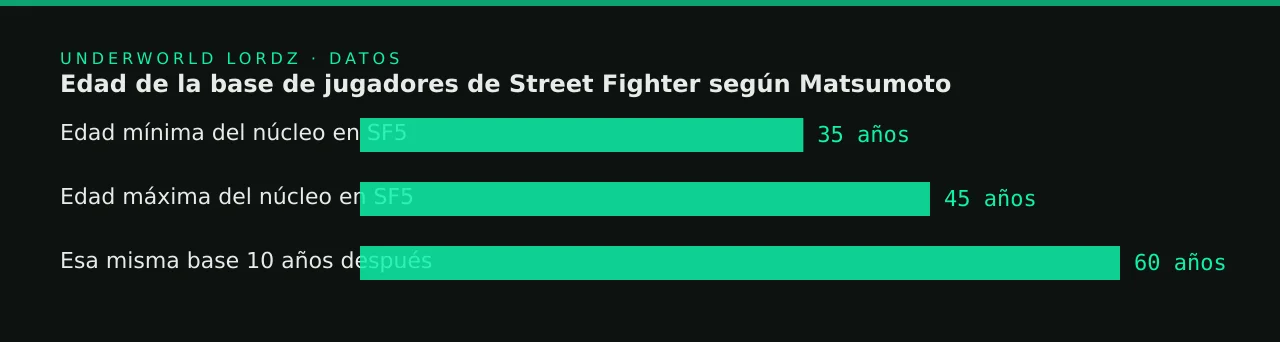
- SF5's player base was between 35 and 45 years old; a decade later, those same people would be approaching 60.
- Yoshinori Ono's departure from Capcom in 2020 marked the start of work on a new Street Fighter designed for both veterans and newcomers.
- The stated goal was a game that would let people get to know the series all over again and come back to play it.
A series that was aging with its players
Matsumoto's core point is that, while Street Fighter 5 was still on the market, he and Nakayama realized the brand would die within about ten years if they did not react. It was not rhetoric: the problem was demographic. A fighting game lives on generational turnover, on a young player watching a tournament, getting hooked and spending years climbing the ranks. If the bulk of the community is between 35 and 45 and nobody new is coming in, the countdown is relentless.
| Period | Age of the player base |
|---|---|
| Street Fighter 5 era | Between 35 and 45 years old |
| Ten years later (Matsumoto's projection) | Around 60 years old |
Matsumoto himself points out that it is hard to sustain a franchise once its audience reaches those ages. Translated into the language of any esports organization: without a pipeline of new talent there is no scene, and without a scene there are no sponsors, no audience and no reason for a studio to keep investing in a niche game.
The handover after Ono's exit
The departure of Yoshinori Ono in 2020, the historic face of the series, opened the door for Matsumoto and Nakayama to take the helm with a twofold mission: do not scare off the veterans and, at the same time, attract new blood. According to GameSpot, that revival strategy ended up giving the franchise fresh energy for a new generation. It is no coincidence that Street Fighter 6 set out to make people rediscover the series rather than assume they already knew it.
The background matters because fighting games are a notoriously conservative genre. For years, studios have designed for people who already know how to play, taking it for granted that new players will either adapt or leave. Capcom's admission shows that this inertia carries a real, measurable cost in years of a brand's life.
Our take
Here at the Underworld Lordz editorial desk we applaud the honesty, but we cannot ignore the obvious: for a series of this caliber to reach that point speaks of years of wrong decisions, and the launch of Street Fighter 5 was the most visible symptom. That today's leadership acknowledges it out loud is a good gesture; that nobody caught it sooner is a lesson for the whole industry.
For competitive players, the message cuts both ways. On one hand, a Street Fighter that courts new players guarantees more opponents, more local tournaments and a livelier scene across the Americas and Europe. On the other, every concession to accessibility breeds suspicion among those who have spent decades refining their execution. Our stance is clear: we would rather have a game that fills venues and Discord chats than a technically pure one that fades away with its last generation of veterans.
For content creators, the lesson is even more direct. A community that does not renew itself produces no clips, no new rivalries and no stories to tell. Street Fighter's survival as a spectacle depends as much on the player stepping in for the first time as on the one who has spent years at the top of the rankings, and Capcom seems to have understood that just in time.
What do you think?
The debate is wide open: the series survived by opening up to new players, but not every veteran is happy with the price paid. Do you think Street Fighter 6 has struck the balance between drawing in newcomers and respecting the old guard, or did the series save itself by sacrificing part of its essence? Tell us in the team chat or on our Discord.
Your turn
What do you think?
Share your take in the team chat or on Discord. We feature the best opinions in the next article.
How did it land?
Community takes
…
Keep reading
Gaming
Capcom admits Street Fighter nearly disappeared after Street Fighter V

Gaming
Capcom clarifies its AI plans for the RE Engine: efficiency is the watchword

Gaming
Capcom wants an AI-powered RE Engine, and the community is already raising an eyebrow

Competitivo
Justin Wong Sports an Evo Moment 37 Neck Tattoo in the Street Fighter Movie
Team guides
SF6: sube de rango con defensa sólida, punish limpio y barra de Drive
Team guides
Street Fighter 6: ajustes, personajes y fundamentos para empezar