
Steam Is Redesigning Deals & Events: Algorithm-Driven Personalized Offers Starting in 2027
By Redacción UWLG · Source: Vandal

Imagen: Vandal
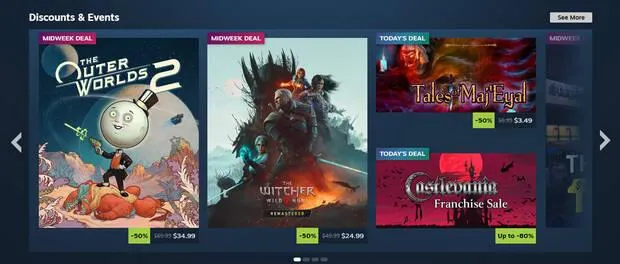
Valve has confirmed that Steam's Deals & Events section is getting a major redesign. It won't arrive with the Autumn Sale, which is running for a week, but in early 2027. The core change is that the section's content will no longer follow a fixed calendar and will instead be chosen by an algorithm, with dynamic, personalized recommendations based on each user's tastes. The original report comes from Vandal.
It may sound like a simple interface tweak, but it isn't. Deals & Events is one of the most-viewed showcases on the world's biggest PC store, and the way it distributes attention determines which games sell and which ones go unnoticed. If who decides what gets shown changes, the rules of the game also change for studios, communities and creators who depend on visibility.

What you need to know
- The Deals & Events redesign will arrive in early 2027, not during the current Autumn Sale.
- Valve will move away from the manual, calendar-based approach, where content was scheduled by partners or by the Steam team itself.
- An algorithm will decide which deals and events each user sees, tailored to their tastes.
- Promotions will be able to appear in more sections of the store, not just in a single space.
- According to Valve, in its tests the section showed ten times more games over the course of the day, and visits to store pages increased.
From calendar to algorithm: what changes
Until now, what you saw in Deals & Events followed a schedule: partners and the Steam team booked slots, and content went live as planned. It's a predictable system, but a rigid one. We all saw more or less the same thing at the same time, and if a game didn't get its moment on the calendar, it had little room to stand out.
The new model breaks that logic. Instead of a shared storefront, each user will have their own, shaped by what they play, search for and buy. Valve says the strategy is already paying off in testing: more games exposed throughout the day, more visits to store pages and, as a result, more sales. In other words, the company is pitching it as an improvement that benefits both users and its own business.
| Aspect | Current model | Model from 2027 |
|---|---|---|
| Who decides the content | Manual calendar set by partners and the Steam team | Recommendation algorithm |
| Type of storefront | The same for everyone | Personalized to your tastes |
| Where deals appear | Mainly in the dedicated section | Across different sections of Steam |
| Games shown per day | Baseline | Ten times more, according to Valve's tests |
Who it affects
Players should, in theory, get more relevant deals and less noise. For studios, especially indie ones, it opens a door: with ten times more games rotating, there are more chances to show up in front of someone who's genuinely interested in what they offer. But there's a flip side: if visibility depends on an algorithm, planning launches and promotions becomes less predictable for sellers.
Our take
At Underworld Lordz, we see this move with a mix of interest and caution. It makes sense for Valve to want to get more out of such a valuable space, and the data it's sharing sounds promising. More games rotating throughout the day is, in principle, good news for discovering titles we'd otherwise never have seen. But it's worth remembering that these results come from Valve itself, and that more visits and more sales are metrics that measure the store's success, not necessarily player satisfaction.
For the competitive scene, the risk is the bubble. If the algorithm notices you spend hours on tactical shooters or fighting games, it will likely keep serving you more of the same. That's convenient, but it can shut the door on that new game that ends up becoming the next big competitive title. Part of the fun of sales was stumbling onto something unexpected, and that doesn't always fit with a system that optimizes for what you already like.
For content creators, the change reads differently. Shared sales were a common talking point: we all saw the same front page and could discuss the same deals. With personalized storefronts, the creator's role as a curator becomes more important, because communities will need someone to tell them what they're missing outside their own bubble. That said, we're asking Valve for transparency and options so each user can adjust or turn off part of that personalization.
What do you think?
There's still time until 2027 to see how it works in practice, but the debate is already on. Would you rather Steam show you deals picked for you, or would you miss the good old shared storefront? Drop by the team chat or our Discord and let us know: do you trust an algorithm to know better than you which game you want to buy?
Your turn
What do you think?
Share your take in the team chat or on Discord. We feature the best opinions in the next article.
How did it land?
Community takes
…
Keep reading

Guías y estrategias
GTA 6 Will Have Uber-Style Fast Travel: Rockstar Puts Its Own Spin on a Classic

Guías y estrategias
Pokémon GO in October 2026: Max Battles, a Fall Harvest and a Packed Schedule

Guías y estrategias
Arc Raiders Goes Free for Five Days: Dates, Platforms and the Fine Print

Guías y estrategias
Metro 2033 and Last Light return with a free next-gen patch: is it enough to revive the series?